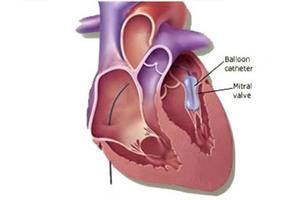
Balloon Mitral
Balloon valvotomy is utilized to increase the opening of a limited (stenotic) valve. It is utilized for:
- > Select patients who have mitral valve stenosis with manifestations
- > Older patients who have aortic valve stenosis, however can’t go through a medical procedure
- > Some patients with pulmonic valve stenosis
PROCEDURE
Balloon valvotomy is a non-surgical procedure done in the cardiovascular catheterization lab center by a cardiologist in Guntur and a specific group of nurses and experts.
Long, thin tubes known as catheters are first positioned into blood vessels in the groin and directed into the heart chambers. The cardiologist then, at that point, makes a tiny opening in the wall between the upper two chambers of the heart. This hole gives an opening to the cardiologist to get to the left chamber with an exceptional catheter that has an balloon at the tip.
The catheter is placed so the balloon tip is straightforwardly inside the narrowed valve. The balloon is expanded and collapsed a few times to enlarge the valve opening. When the cardiologist has really determined the opening of the valve has been enlarged enough, the balloon is deflated and taken out.
During the procedure, the cardiologist might carry out an echocardiogram (ultrasound of the heart) to get a better image of the mitral valve.
AFTER THE METHOD
- > You should lay flat for around 6 hours after the catheter has been taken out from your groin to forestall bleeding. You will have a tight cumbersome dressing on your groin region while you are resting in bed. Try not to twist your legs during this chance to forestall bleeding. A sheet might be set across your legs to remind you to keep them straight. Your nurse will let you know when you might sit up and get out of the bed.
- > You ought not to eat anything until the catheter has been eliminated from your groin
- > Notify your nurse quickly if you have a fever, chest pain, swelling or pain in your groin or leg, or bleeding at your groin site.
- You will have an echocardiogram the morning after the surgical procedure.
- Medications might be recommended. Inquire as to whether it is safe to keep taking the drugs you took preceding the procedure.
- Once you have recuperated from the procedure and have conversed with your doctor about your subsequent appointments and care, you will actually want to return home.