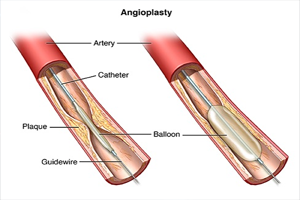
PTCA, or percutaneous transluminal coronary angioplasty, is a minimally invasive procedure that opens obstructed coronary arteries to enhance the blood stream to the heart muscle.
Initially, a local anesthesia numbs the groin region. Then, at that point, the best doctors for heart attack in Guntur places a needle into the femoral artery, the artery that runs down the leg. The specialist places a guide wire through the needle, eliminates the needle, and replaces it with a speaker, an instrument with 2 ports for placing flexible devices. Then, at that point, the guide wire is supplanted by a thinner wire. The specialist passes a long narrow tube known as diagnostic catheter over the new wire, through the introducer, and into the artery. When it’s in, the specialist guides it to the aorta and eliminates the guide wire.
With the catheter at the opening of a coronary artery, the specialist at cardiology hospitals in Guntur infuses dye and takes a X-ray. In the event that it shows a treatable blockage, the specialist backs the catheter out and replaces it with a directing catheter, prior to eliminating the wire.
Thinner wire is placed and guided across the blockage. A balloon catheter is then directed to the blockage site. The balloon is blown for a couple of moments to compress the blockage against the artery wall. Then, at that point, it’s collapsed. The specialist might blow up the balloon a couple of more times, each time filling it a more to augment the passage.
Across this purpose of diagnostic tests, it’s essential to know that they don’t treat patients or cure sicknesses, but are a vital step toward both. They don’t come into direct contact with the patient as they just need a sample from the patient to produce results. The effect of these outcomes on medical care decisions is critical and imperative, however it additionally depends on a clinical expert’s exact judgment and appropriate decision of therapy. In diagnostic tests, its acts as a guide to give fundamental data on wellbeing and its consideration.