Pericardiocentesis
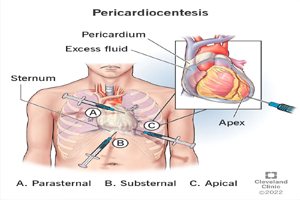
Pericardiocentesis in Guntur is an invasive procedure. It utilizes a needle and catheter to obtain the fluid from your pericardium. The liquid would then be able to be sent to a lab for microscopic assessment for abnormal cells.
This test is frequently used to assist with diagnosing an infection, cancer, or the reason for additional fluid encompassing your heart. The technique can likewise be utilized to ease indications like shortness of breath.
At the point when an excess of fluid is caught in your pericardium, this is known as pericardial effusion. This can keep your heart from pumping regularly on the grounds that the additional liquid causes pressure. Pericardial effusion can prompt a dangerous condition known as heart tamponade. In this condition, your heart turns out to be too compressed to even consider working ordinarily. Cardiovascular tamponade is dangerous and should be dealt in a right way.
PROCEDURE
- A pericardiocentesis is generally done in an emergency care unit, yet it very well might be done at your bedside or in the emergency division that you experience pericardial effusion.
- You will be asked to lie down on a exam table and placed at a 60-degree angle. An IV will be begun to give you any liquids or meds in the event that you have an extreme drop in blood pressure or eased back heartbeat during the procedure. The skin underneath and around your breastbone will be cleaned, and local numbing agent will be applied. You may likewise be given a narcotic, yet you will stay alert for the surgery.
- A needle is then placed into your pericardial sac. You may feel some strain while the needle goes in. It is directed by echocardiogram, which provides your surgeon with a moving image of your heart, like a ultrasound. This will likewise assist with monitoring fluid drainage. When the needle has been put accurately, your doctor will supplant it with an exceptionally flimsy cylinder known as a catheter. The procedure requires 20 to 60 minutes
- The catheter remains in place to let fluid drain through it access to a container, in some cases for a considerable length of time. When the liquid has depleted, the catheter is eliminated.
- Contingent upon the institution, cardiologist in Guntur, your standpoint, and the reason for emission, more invasive surgical drainage than needle pericardiocentesis might be needed.
POST SURGERY
- At the point when the catheter is eliminated, stitching of the area is done or heavy bandaging, as required. The patient is kept in the hospital for a day or two. The patient can continue their schedule seven days after the specialist’s advice. They are encouraged to keep a healthy lifestyle which incorporates exercising, maintaining a good diet and regular cardiac checkups.